
Guide
India has a visa made for one purpose: coming for treatment. If you are planning surgery or a longer course of care in Delhi NCR, this is the one to travel on. Getting it is not hard, but it has its own rules and its own papers, and small mistakes cost days.
Below, each part comes in the order you will meet it. Rules do change, so for every fact we name the official page it comes from, and you can check it yourself.
Who needs a medical visa for India?
Anyone without Indian citizenship who is coming mainly for treatment. That covers a check-up that may lead to surgery, a transplant, cancer care, IVF and treatment under the Indian systems of medicine (Ayush).
Please do not come on a tourist visa planning to switch later. The official e-Visa website says an e-Visa can be neither extended nor converted into another visa. A hospital may also ask to see your visa before it admits you for a planned operation.
Medical visa and medical attendant visa: what is the difference?
The patient gets a medical visa. The people who travel to look after them get a medical attendant visa. On the online route, the official e-Visa website says only two e-Medical Attendant visas are granted against one e-Medical visa, so one patient can bring two attendants at most.
Everyone fills in their own application, pays their own fee and needs their own passport, children included. The attendant visa is tied to the patient's: Indian missions describe it as running for the same period as the patient's medical visa.
As for who can be an attendant, Indian missions say it is usually a husband or wife, a child or another blood relative. If a friend or a more distant relative is coming instead, some missions ask the patient to sign an undertaking. Check with the mission that handles your application.
How do you apply for a medical visa for India, step by step?
This is the usual order, and on the online route all of it can be done from home.
- 1Send your reports to a hospital
A specialist reviews them and suggests a plan. We arrange this with the hospital you choose.
- 2Get the hospital's visa letter
The International Patient Department writes it on letterhead, with your admission date. Check every name and passport number.
- 3Find your route
Look for your nationality on the e-Visa list on the official website. If it is not there, you apply at the Indian mission in your country.
- 4Apply and pay the fee
The patient and each attendant apply separately. The fee depends on your nationality and is not refunded.
- 5Wait for the decision
It comes by email, and you can check the status on the same website.
- 6Book your flights
Only after the visa is granted. Print the approval and carry it with you.
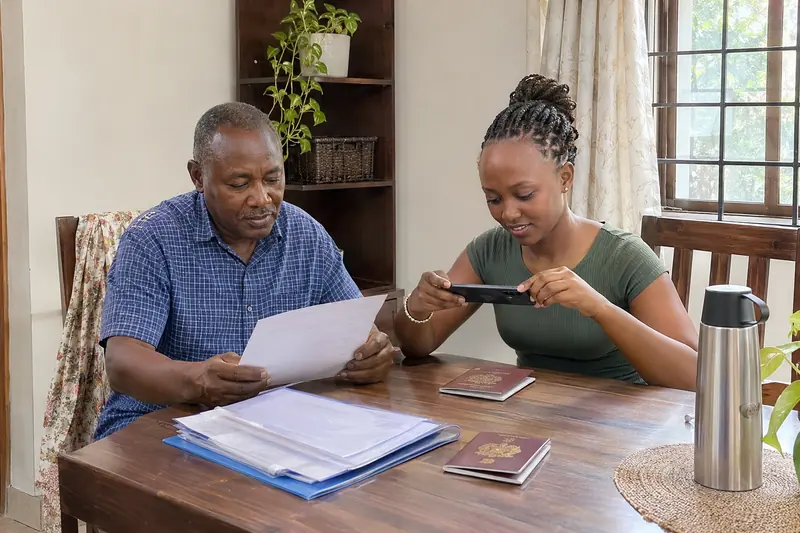
Two things catch many families out. One: the hospital letter comes before the visa application, so the medical review has to happen first. Two: the attendants apply at the same time as the patient, not afterwards. If the patient's visa comes through and the son's is still pending, the whole trip waits.
What documents do you need for a medical visa for India?
For the e-Medical visa, the official e-Visa website asks for just two things: a scan of your passport's main page, and a copy of the Indian hospital's letter on its letterhead, giving the date or likely date of admission. Attendants applying online need their passport page and a photo.
At an Indian embassy or high commission the list is longer. As one example, the High Commission of India in Nairobi lists these papers for a medical or medical attendant visa:
Your name, passport number, illness, how long treatment will take and its estimated cost
Your diagnosis and why you need treatment in India
Valid for at least 6 months, with blank pages; the original and a copy
Plain light background, full face, no glasses
Shows you can pay for treatment and the stay; a sponsor adds a signed undertaking
For travellers from, or passing through, countries with yellow fever
A birth or marriage certificate showing how you are related
Some missions want the letters sent straight to them: the Nairobi mission asks both your local hospital and the Indian hospital to email their letters directly to its visa section. Follow your own mission's instructions exactly.
Coordinator's tip: Before applying, lay the hospital letter next to each passport and check the spelling of every name, letter by letter. A name that does not match the passport is the most common reason a visa or a hospital admission gets held up.
When to apply for a medical visa and how long it takes
Online, the official e-Visa website lets you apply for an e-Medical or e-Medical Attendant visa as early as 120 days before your arrival date and no later than 4 days before it. The fee too must be paid at least 4 days before you travel, or the application is not processed.
Four days is the legal minimum, not a plan. Give yourself two to three weeks if you can, so there is time to fix a wrong photo or a missing page. Embassy applications usually take longer and may need an appointment, so start those first.
Do not pay for flights first: Hold off on tickets you cannot change until every traveller's visa is granted. The e-Visa fee is not refunded if a visa is refused or the trip is cancelled.
Each family's case is a little different: the country you live in, the treatment, who travels with you. If you are unsure which papers you need, ask us before you apply.
Arriving in India: airport, fingerprints and arrival card
e-Visa holders must enter India through one of the international airports listed on the official e-Visa website. Delhi is on the list, along with Mumbai, Chennai, Hyderabad, Bengaluru and others. You may leave India from any immigration checkpoint.
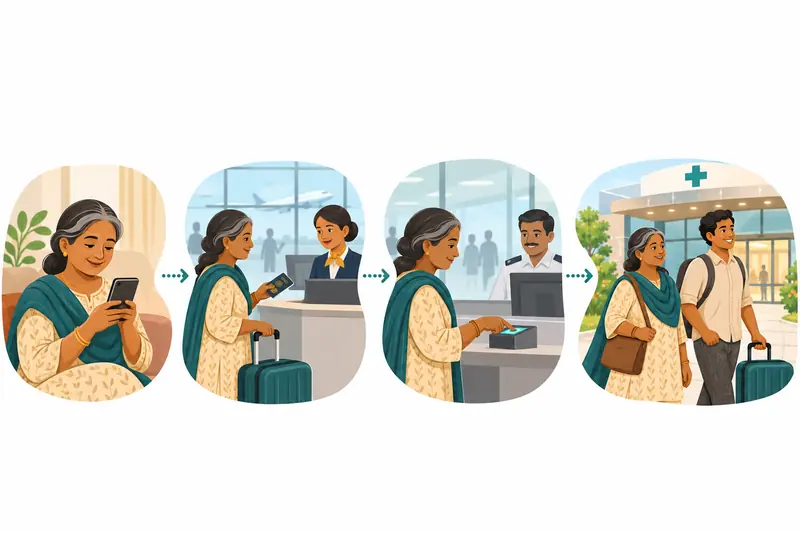
Immigration takes your fingerprints and photo; the website says every e-Visa holder goes through this. The same site asks foreign visitors to fill in an online e-Arrival card within 72 hours before landing. It is not a visa, just arrival information, but it saves time in the queue. Once you are through, an Indian SIM card makes it easy for the hospital and our team to reach you.
Health certificates are checked at the airport too. The official e-Visa website warns that people arriving from yellow fever countries without a vaccination card can be quarantined for up to six days. Nigeria, Kenya, Ethiopia and Ghana are on the yellow fever list. The High Commission of India in Abuja also asks Nigerian travellers for a recent polio vaccination certificate.
What if your treatment takes longer than planned?
Most treatments fit easily inside the visa. A knee replacement, for example, usually means 10 to 14 days in India. Others take far longer: a living donor kidney transplant often means 4 to 8 weeks. If your doctor expects a long stay, tell us early, because it can decide which visa route suits you.
The official e-Visa website lists the e-Medical visa as multiple entry, so on the online route you can usually go home and come back for a follow-up within its validity. Go by the validity dates printed on your own approval, not by a general rule.
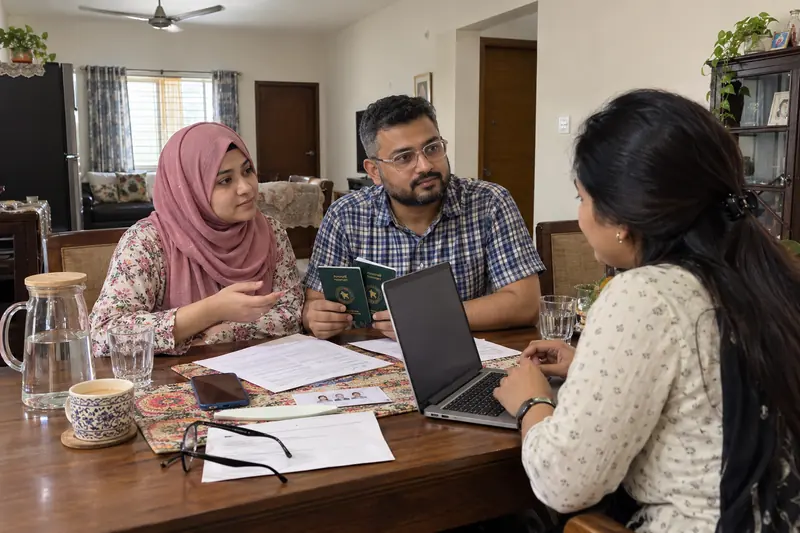
On a regular medical visa for more than 180 days, Indian missions say you must register with the Foreigners Regional Registration Office (FRRO) within 14 days of arrival. Registration and other services happen online through the e-FRRO portal, and the hospital and our team help with the papers.
Good to know: Indian missions warn that nobody can sell you a faster visa. Fees go only to the official website or the mission. No one else should ask you for money to "speed up" an appointment.
How Optimist Healthcare helps
Our job is to coordinate; we are not a hospital. Once a specialist has reviewed your reports and you pick a hospital, we ask its International Patient Department for the visa letter and check it against your passports before it goes out. We tell you which route fits your nationality, go through the form with you, and meet you at the airport in Delhi.
What we cannot do is apply on your behalf or promise a result. The visa decision belongs to the Government of India, and the application is yours to sign.