
Guide
Nearly every large private hospital in India puts two logos on its website: JCI and NABH. You will keep seeing them while you compare treatment. So what do JCI and NABH accreditation actually check, and how much weight should they carry when you decide where to be treated?
Below we cover who gives each one, what the inspectors look at, how long they last, how to check them yourself and, just as useful, what they cannot tell you. We wrote it for families from Nigeria, Kenya, Ethiopia, Ghana, Oman, Bangladesh and nearby countries.
What is hospital accreditation?
Hospital accreditation is a quality mark from an independent body, given after its trained assessors inspect a hospital against written standards. No hospital can award it to itself, and it has to be renewed.
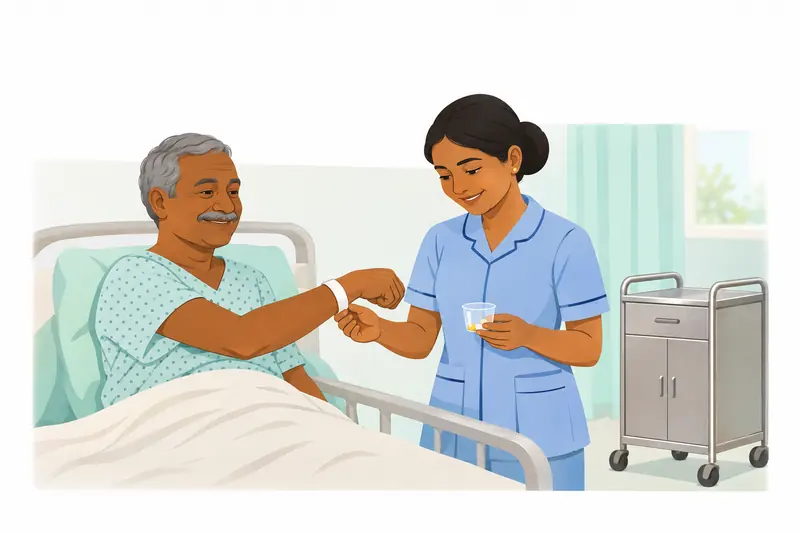
It looks at systems, not at individual doctors. Inspectors want to know whether the hospital has safe ways of working, and whether staff actually follow them: how patients are identified, how medicines are stored and given, how infections are kept down, how fire and power cuts are handled, how staff are trained and how records are kept.
Nobody in India is forced to get accredited. A hospital chooses to apply, pays for the assessment, and has to keep meeting the standards to hold on to the mark. For a patient abroad who cannot walk round hospitals before deciding, that makes it a useful first filter.
Why accreditation matters more when you travel
Back home, you probably know which hospital the neighbours trust, or which doctor has seen your family for years. Abroad, all of that is gone. You are choosing from a distance, often in a hurry, sometimes right after hearing that the treatment you need is not available near you.
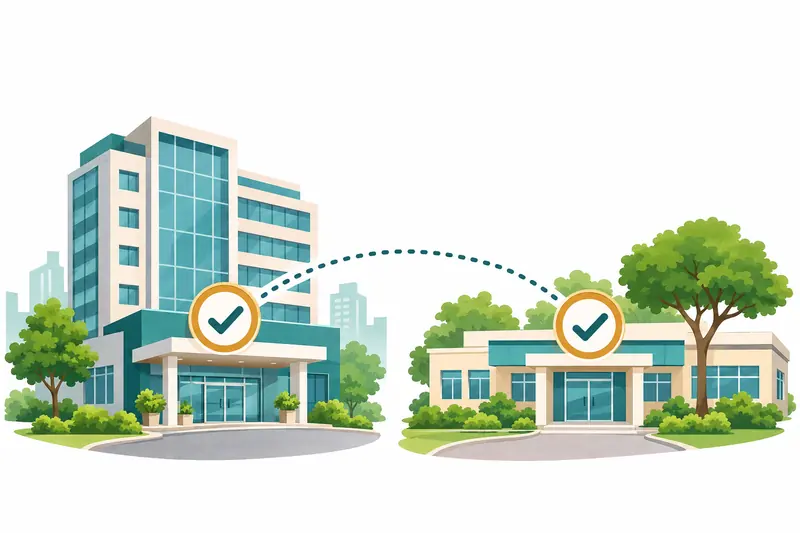
Accreditation fills some of that gap. The check is done by people who gain nothing from your choice, against standards anyone can read. It also gives you one yardstick: if two hospitals in different cities are both NABH accredited, both have passed the same kind of inspection.
There is a practical side as well. If an insurer, an employer or a government scheme is paying, ask them early whether they insist on a JCI or NABH hospital; some do. Accredited hospitals are also used to keeping complete records, which makes it easier for your doctor at home to take over your care.
What is JCI accreditation?
Joint Commission International (JCI) is the international arm of The Joint Commission, the body that accredits hospitals in the United States. It accredits hospitals and clinics in many countries. Its hospital standards are in their 8th edition, used since January 2025.
A team of JCI surveyors spends several days inside the hospital. They follow real patients through their care, read records, talk to staff, and walk through wards, operating theatres and kitchens. The accreditation usually runs for three years, after which the hospital is surveyed again.
Six International Patient Safety Goals sit at the centre of the JCI standards. Here is what each one means for you in a hospital bed:
| JCI safety goal | What it means for you |
|---|---|
| Identify patients correctly | Staff check your name and a second detail, such as your date of birth, before tests, medicines or blood |
| Improve effective communication | Spoken orders and urgent test results are written down and read back |
| Improve the safety of high-alert medicines | Strong medicines are stored apart and double-checked |
| Ensure safe surgery | The right patient, the right operation and the right side, confirmed in a pause just before surgery starts |
| Reduce the risk of infections | Hand hygiene and infection control are watched and measured |
| Reduce the risk of harm from falls | Patients likely to fall are identified and protected |
What is NABH accreditation?
The National Accreditation Board for Hospitals and Healthcare Providers (NABH) is India's own accreditation body. It sits under the Quality Council of India, and is itself recognised by ISQua, the International Society for Quality in Health Care, which reviews accreditation bodies around the world.
From 1 January 2025, hospitals have been assessed against the 6th edition of the NABH standards: 10 chapters, 100 standards and, under them, 639 checks called objective elements. Of those, 105 are "core" elements, mostly on safety, and they are looked at in every assessment.
Between them, the chapters cover the whole hospital: admission and assessment, care of patients, medicines, patient rights and education, infection prevention, patient safety and quality, management, buildings and safety, staff, and records. For a patient from abroad, one standard stands out. NABH says patients and families have a right to information on expected costs, and the hospital's price list should be available to them. Earning and keeping NABH accreditation works like this:
- 1The hospital applies
It follows the standards for at least three months, then sends its documents to NABH.
- 2Review and on-site assessment
NABH goes through the documents, then trained assessors inspect the hospital in person.
- 3A certificate for four years
If it meets the criteria, the hospital is accredited for four years.
- 4A check around year two
Assessors come back for a surveillance assessment between 21 and 24 months.
- 5Renewal
Six months before the four years are up, the hospital applies again and is reassessed.
JCI vs NABH: what is the difference?
Both are serious, independent inspections. They differ mainly in who runs them, where they apply, and how well known they are outside India.
Joint Commission International, based in the United States
NABH, under the Quality Council of India
Hospitals in many countries
Hospitals in India
8th edition, since January 2025
6th edition, since January 2025
Usually three years, then a new survey
Four years, with a check around year two
Patients and insurers worldwide
Patients, insurers and health schemes in India
Plenty of large hospitals in Delhi NCR hold both. A hospital with only NABH can still be very good. It is a demanding standard, and far more Indian hospitals have it than have JCI. For a major operation, though, patients from abroad often lean towards a hospital with both. Most hospitals we coordinate with report both for their main campus, and each hospital page shows what we checked.

Reading policies is only part of a visit. The team looks at small things on an ordinary day: is the hand-rub bottle by the bed full, does the nurse check the wristband before giving a medicine, is the fire exit clear?
What accreditation does not tell you
Accreditation is a strong signal, but it answers one question only: does this hospital have safe systems? Most of your other questions it leaves open.
Common mistakes:
- Not true: An accredited hospital is the best hospital for my condition. It checks systems across the whole hospital. It does not rank departments, and it says nothing about how often a team does your operation.
- Not true: The badge on the website proves the accreditation is current. Accreditation runs out, and it can be taken away. Look up the exact campus on the official NABH or JCI list.
- Not true: Accreditation guarantees a good result. The CDC in the US says as much: accreditation does not guarantee a good outcome. How you do depends on your condition, your specialist and your recovery.
Treat it as your first filter. After that, ask about the department and the specialist: how often they treat your condition, who leads your care and what happens if something goes wrong. Your written opinion and estimate should answer all of that before you travel.
Nor will accreditation tell you what you will pay, how long you will stay in India, or how the hospital keeps in touch once you are home. Those answers come from the written opinion and estimate for your case, so get both on paper and keep them with your travel documents.
How to check a hospital's accreditation yourself
Five minutes on your phone is enough, and you can do it alone. Start with the exact name and address of the hospital that will treat you; it is usually on your estimate or visa invitation letter. Then search for it on the official lists.
The lab has a mark of its own. Blood counts, biopsies and similar tests usually happen in the hospital's laboratory, which NABL, another board under the Quality Council of India, can accredit separately.

Sit down with the family member who is coming with you and do it together. Search the hospital's name on the NABH and JCI lists, and read the city and campus, not just the name. One group can run several hospitals with nearly the same name in the same city.
Note down what you found. If the hospital changes, or your treatment shifts to another campus, look again.
Coordinator's tip: Screenshot the hospital's entry on the NABH or JCI list so the date shows. Save it with your estimate and visa letter, and forward a copy to family at home.
Every hospital page on our site shows the accreditation reported for that campus. Take it as a starting point, then confirm it on the official lists.
Found a hospital and want to be sure its accreditation is real? Tell us its name and campus along with your reports, and we will look it up on the official lists with you.