Guide
Is medical treatment in India safe?
Yes, for most international patients, provided three things are in place: an accredited hospital, a registered specialist who has studied your reports, and a written plan agreed before you fly. Those three count for far more than the name of the country on your ticket.
Asking is completely reasonable. You are thinking of an operation far from home, in a city you may never have seen, with doctors you have met only on a video call. Families from Nigeria, Kenya, Ethiopia, Ghana, Oman and Bangladesh ask us this every day, and they should get a straight answer, not a sales pitch.
Below you will find what makes a hospital safe, which worries are myths and which are real, the extra risks of travel, and the simple steps that lower them. What you will not find is a promise about results. No hospital anywhere can make one.
What makes a hospital safe, in India or anywhere?
Safety is something you can check, not something you have to feel. The checks are the same in Delhi, Nairobi, Lagos, Muscat or London.
Accreditation comes first. Most large private hospitals in Delhi NCR are accredited by NABH, India's national hospital standard, and many by JCI, an international body, as well. Inspectors visit and look at how the hospital prevents infection, gives medicines, confirms the right patient and the right operation, and deals with emergencies. It is not a one-time award: accreditation has to be renewed, with fresh inspections.
Next comes the doctor. Anyone treating patients in India must be registered with the National Medical Commission or a State Medical Council. Senior specialists at the big hospitals usually do the same kind of operation many times a week, and that experience counts.
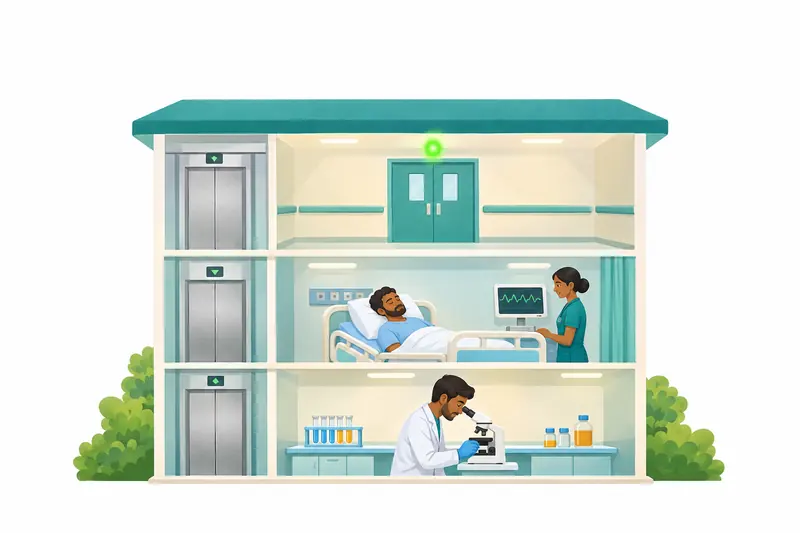
Then there is everything around the operation: intensive care on site in case recovery does not go to plan, a laboratory and blood bank in the same building, and staff who explain things clearly and put them in writing.
- Outside inspection: NABH or JCI inspectors check the hospital against written standards
- Registered doctors: every doctor is on an Indian medical council register
- Intensive care on site: specialist help is close by if recovery does not go to plan
- Records in English: reports, discharge summary and bills you can take home
Common worries about treatment in India, answered honestly
A lot of the fear comes from old stories, or from one bad experience at a clinic that was never accredited. Some worries are fair. Others fall apart once you look closely. These are the ones our team hears most.
Lower prices must mean lower standards
Prices are lower mainly because salaries, buildings and day-to-day running costs are lower in India. Safety comes from inspection and training, not from the size of the bill.
A famous hospital name is all I need to check
Accreditation is given campus by campus. Check the exact hospital and address where you will be treated, not only the group's name.
An accredited hospital means nothing can go wrong
Accreditation shows that safety systems are in place. It does not guarantee a good result, and America's Centers for Disease Control and Prevention (CDC) reminds travellers of exactly that.
I will not be able to talk to my doctors
Doctors in India train in English and use it all day. Large hospitals also have interpreters for languages such as Arabic, French and Swahili.
The fair worries are about the travel itself and about what happens once you are home. Those are real, so the next section deals with them openly.

What are the real risks of travelling for treatment?
Every operation has risks, and in India they are much the same as at home: infection, bleeding, a reaction to anaesthesia, or a slower recovery than you hoped. Your doctor should explain the risks of your own treatment in writing before you agree to it.
Travel adds a few. According to the CDC, infection is the most common complication for people who travel for treatment, and flying soon after surgery raises the chance of blood clots. As one example, it suggests waiting about 10 days before flying after chest or belly surgery. Your own date is your surgeon's call.
Other travel risks are practical: a long trip home while you are still tired, medicines bought from the wrong shop, and the distance from the team who operated once you are back. Planning lowers most of them; luck has little to do with it.
- CommonTiredness, swollen ankles and stiff legs after a long trip
Rest, short walks, plenty of water, and flying only when your doctor says you are fit
- UncommonWound or other infection after surgery
Good hospital infection control, a wound check before you fly, and knowing the warning signs at home
- UncommonA clot in a leg vein or the lung after surgery and a flight
Walking early, blood thinners if your doctor advises them, and not flying too soon
- RareFake or badly stored medicines
Buy medicines only from the hospital pharmacy or a licensed chemist, and keep the labels
Source: CDC Yellow Book 2026: Medical tourism (cdc.gov)
What happens if something goes wrong during treatment in India?
Many patients are afraid to ask this, and it is exactly the right question. At an accredited hospital, a complication is handled by the same team in the same building, with intensive care, scans and specialists nearby. Nobody has to move you to another hospital to get help.
Before you travel, ask two things. How does the hospital deal with a complication after your kind of treatment? And what happens to the bill: which extra costs could be added, and how would you be told? A good hospital answers both clearly, and the second answer belongs in your written estimate.
How to make your treatment in India as safe as possible
Not everything is in your hands, but the decisions that matter most are. We ask every patient to follow these steps, whoever they end up working with.
- 1Share your full reports before deciding
Scans, blood tests and letters from your own doctor let the specialist judge your case properly.
- 2Get a written opinion from a named specialist
It should say what is wrong, what is advised, and the risks for you.
- 3Check the hospital and the doctor yourself
Look up the accreditation and the doctor's registration on the official registers.
- 4Get the estimate from the hospital, in writing
An itemised estimate on hospital paper, not a figure in a chat message.
- 5Plan enough days to recover before you fly
The hospital tells you how long to stay in India for your treatment.
- 6Agree your follow-up before you leave
A discharge summary, video check-ups and a doctor at home who has your reports.
For the third step, our guide on how to verify an Indian hospital's credentials shows each official website and what to look for on it.
Hold nothing back from the doctors. Tell them about every illness, every medicine and every operation you have had, even the small ones. A safe plan needs the full picture.
Do not cut your stay short: Flying home before your doctor says you are fit is one of the easiest risks to avoid when you are treated abroad. Book a ticket you can change, and budget for the full stay.
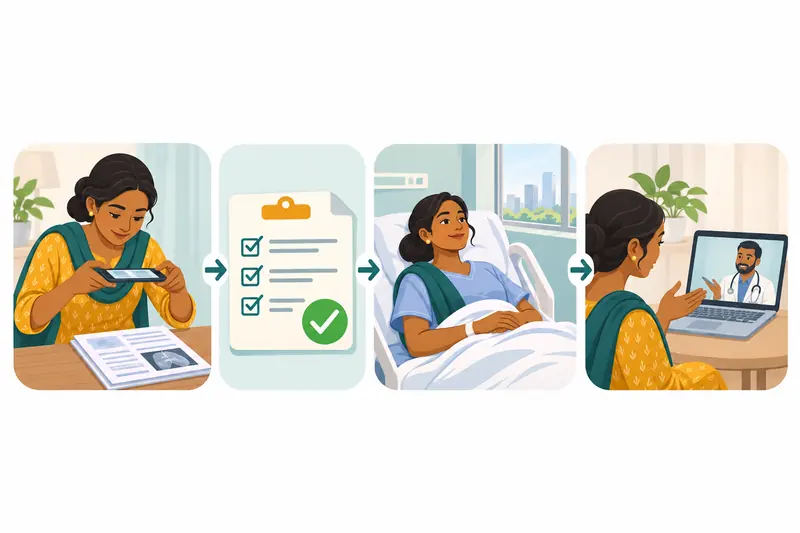
What happens after I get home?
Your care does not stop at the airport. Before you leave India, the hospital hands you a discharge summary in English: what was done, the medicines to take, and the signs that mean you should see a doctor quickly, such as fever, a red or leaking wound, new swelling in one leg, or sudden breathlessness.
Give a copy to your own doctor and keep one on your phone. Most hospitals can review new reports or speak to you on a video call in the weeks after you return. Before you fly, find out who to contact, and how.
Money, scams and people pretending to help
Staying safe also means protecting your money. Fraudsters target people who travel for treatment. They copy the names and logos of hospitals, doctors and medical travel companies, then ask for "registration fees" or "deposits".
One rule covers it: treatment is paid to the hospital, at the hospital or into the hospital's own account shown on its official invoice. Your visa is paid on the Indian government's own e-Visa website. Optimist Healthcare never asks patients to pay us, and never asks anyone to send money to a personal account.
If anything feels off, stop and do not pay. Our scam warning page lists our only contact details and the things we will never ask you for.
How Optimist Healthcare fits in
Optimist Healthcare is a facilitator, not a hospital. We send your reports to specialists at accredited partner hospitals in Delhi NCR, pass on their written opinion and the hospital's own estimate, and help with the visa letter, travel and your stay. The doctors and the hospital treat you, and they are responsible for your care.
Please check our work rather than simply trusting it. Ask us for the doctor's name and registration number, the hospital's accreditation, and anything else you want to see. A decision you have checked yourself is one you can stand behind.